






MLOPs – Automating the Lifecycle of Machine Learning Systems

Most machine learning conversations stop at model accuracy — but real-world AI doesn’t. A model that performs well in a notebook is only the beginning. The real challenge lies in deploying it reliably, monitoring its behavior, and ensuring it continues to deliver value as data and business conditions evolve. This is where MLOps comes in — bridging the gap between experimentation and production. By combining machine learning with DevOps principles, MLOps enables teams to automate pipelines, maintain reproducibility, monitor performance, and continuously improve models at scale

Table of Contents

Introduction

A complete guide for teams building scalable, reliable, and continuously improving AI solutions.

Most machine learning discussions focus on model building selecting algorithms, tuning hyperparameters, improving accuracy, and interpreting results. But in the real world, the journey doesn’t end when the model works on a Jupyter notebook.

For organizations deploying AI at scale, the real challenge is ensuring:

  1. Models can be deployed to production consistently
  2. Their performance stays stable over time
  3. They are retrained when the world changes
  4. Engineers, data scientists, and DevOps work efficiently together


This is where MLOps comes in.


MLOps (Machine Learning + DevOps) provides the tools, practices, and automation needed to take ML from experimentation to full-scale production systems.


This blog walks through the entire lifecycle — from training to deployment — and explains how real companies use MLOps to deliver reliable AI solutions.

MLOps - Automating the lifecycle of Machine Learning Systems

1. What is MLOps?

MLOps is a framework of workflows, tools, and best practices that ensures: 

  • Reproducibility → every experiment can be recreated 
  • Scalability → models run reliably for millions of users 
  • Automation → rebuilding, validating, and deploying models becomes a pipeline 
  • Monitoring → you always know how your models are behaving 
  • Governance → versions, lineage, datasets, and metrics are tracked 


Think of MLOps as the bridge between: 

Data Science Experiments 

and 

Production-Grade Systems 

2. The Real-World ML Lifecycle

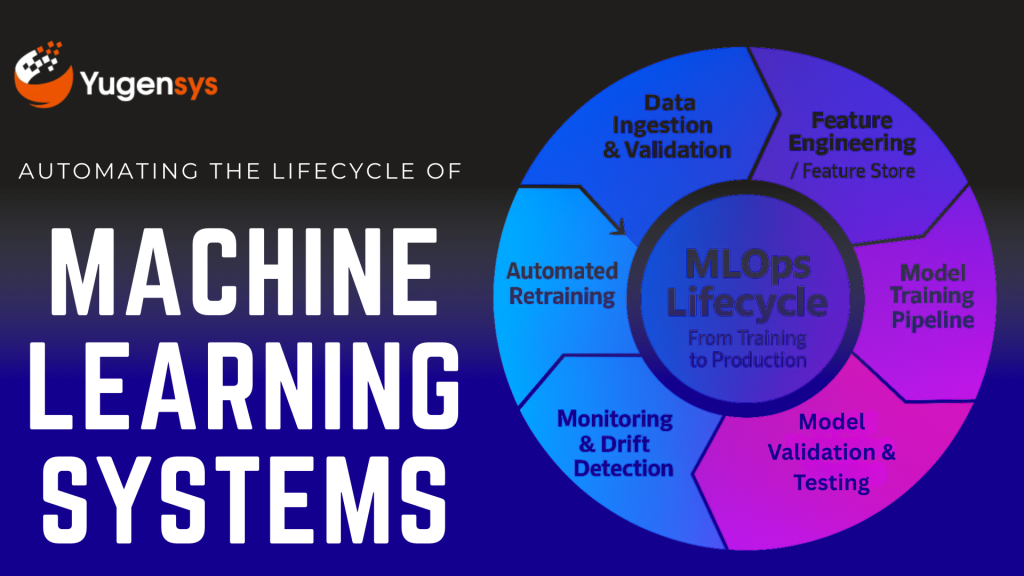
A typical MLOps pipeline includes: 

  1. Data ingestion & validation
  2. Feature engineering & feature storage 
  3. Training pipelines 
  4. Model validation 
  5. Versioning (data + model + code) 
  6. Automated CI/CD for ML 
  7. Deployments (batch or realtime) 
  8. Monitoring (performance + drift) 
  9. Retraining triggers 


Let’s break these down. 

3. CI/CD for Machine Learning

Traditional CI/CD doesn’t work for ML because: 

  • Data changes 
  • Data quality changes 
  • Model performance varies 
  • Training can take hours 
  • Metrics—not just code—determine correctness 


ML CI/CD extends DevOps by adding: 

Our Services

Book a Meeting with the Experts at Yugensys


3.1 Continuous Integration for ML (CI)

This includes automated steps like: 

  • Checking code quality 
  • Checking data schema 
  • Running unit tests on data transformations 
  • Validating training logic 
  • Running small training jobs to verify pipelines 


Tools commonly used: 

  • GitHub Actions 
  • Jenkins 
  • GitLab CI 
  • Azure Pipelines 
  • AWS CodePipeline 

3.2 Continuous Delivery for ML (CD)

Automatically: 

  • Validates model performance 
  • Compares new models vs existing live model 
  • Pushes approved models to the model registry 
  • Deploys models to production environments 

4. Monitoring in MLOps

Once deployed, a model can fail silently. 

Real-world failures include: 

  • Data Drift: incoming data distribution changes 
  • Concept Drift: relationship between features & output changes 
  • Model Skew: training vs production data mismatch 
  • Feature drift: sudden changes in important variables 
  • Performance degradation: accuracy drops over time 

4.1 What should you monitor?

Type of Monitor 

What It Detects 

Prediction metrics 

Accuracy, precision, recall, AUC, RMSE 

Data drift 

Change in input feature distribution 

Concept drift 

Business KPI mismatch (e.g., fraud model missing new fraud patterns) 

Service health 

Latency, timeouts, errors 

Feature availability 

Broken pipelines, null values, missing features 

4.2 Monitoring Tools

  • Evidently AI 
  • Prometheus + Grafana 
  • AWS SageMaker Model Monitor 
  • Feast + custom dashboards 
  • MLflow monitoring 

Monitoring isn’t optional — it prevents silent failures that businesses may discover weeks later. 

5. Feature Stores: A Crucial Component

In most ML systems, feature engineering takes 60–80% of the effort. 

Feature Store solves: 

  • “Where are our features defined?” 
  • “Are we using the same features in training and production?” 
  • “How do we share features across teams?” 


Benefits of feature stores: 

  • Centralized and reusable feature definitions 
  • Prevent duplicate feature work 
  • Real-time & batch feature serving 
  • Point-in-time correctness 
  • Guarantees training-serving parity 


Tools include: 

  • Feast (Open-source) 
  • AWS SageMaker Feature Store 
  • Snowflake Feature Store 
  • Databricks Feature Store 

6. Versioning — The Foundation of Reproducibility

Unlike software, ML requires versioning of three elements:

6.1 Code Versioning

  • Python scripts 
  • Notebooks 
  • Preprocessing logic 
  • Model architecture 

6.2 Data Versioning

  • Raw datasets 
  • Processed datasets 
  • Training/validation/test splits 

Tools: DVC, LakeFS, Delta Lake 

6.3 Model Versioning

  • Model binaries (pickle, ONNX, TensorFlow SavedModel) 
  • Model metrics 
  • Model lineage 
  • Deployment history 


Tools: MLflow, SageMaker Registry, Vertex AI Model Registry 


Versioning ensures complete auditability — crucial for compliance-heavy industries. 

7. Model Deployment Strategies

There is no single “best” way to deploy models. It depends on: 

  • Latency requirements 
  • Data size 
  • Inference cost 
  • Real-time vs batch needs 

7.1 Batch Deployment

✔ Long processing pipelines 
✔ Non-real-time use cases 
✔ High-throughput tasks 

Examples: 

  • Nightly demand forecasting 
  • Monthly credit risk scoring 
  • Weekly customer segmentation 


Infrastructure: 

Airflow, AWS Batch, Databricks, Spark 

7.2 Real-Time Deployment

✔ Low-latency predictions 
✔ User-personalization 
✔ Fraud detection 
✔ Chatbots, Recommendation engines 


Common approaches: 

  • REST API microservices 
  • Serverless inference (AWS Lambda / Cloud Functions) 
  • Managed endpoints (SageMaker / Vertex / Azure ML) 


Tech choices: 

  • FastAPI 
  • Flask 
  • TorchServe 
  • TensorFlow Serving 
  • Kubernetes + Istio 

8. Infrastructure Choices: Containers, Kubernetes, Serverless

8.1 Docker + Containers

  • Best for reproducibility 
  • Lets you package code + dependencies 

8.2 Kubernetes (K8s)

Best for: 

  • High-scale ML systems 
  • Complex workflows 
  • Rolling updates 
  • Auto-scaling 


Often paired with: 

  • Kubeflow 
  • MLflow 
  • Argo Workflows 
  • Seldon 

8.3 Serverless Inference

Best for: 

  • Light-weight models 
  • Intermittent traffic 
  • Cost-sensitive teams 


Examples: 

  • AWS Lambda 
  • Azure Functions 
  • Cloud Run 

9. Automated Retraining Strategies

Models degrade — it’s inevitable. 

Retraining triggers can be: 

9.1 Time-based retraining

Daily / Weekly / Monthly pipelines 

Useful for stable domains (retail, demand forecasting) 

9.2 Data-based retraining

Triggered when: 

  • New dataset arrives 
  • Feature distributions shift 

9.3 Performance-based retraining

Triggered when: 

  • Accuracy drops below threshold 
  • Drift exceeds limits 

9.4 Human-in-the-loop retraining

Labelers add new examples 

Useful for NLP / customer service systems 

10. Putting It All Together — A Modern MLOps Architecture

A typical MLOps system includes: 

  • Data Lake / Warehouse (S3, BigQuery, ADLS) 
  • ETL Pipeline (Airflow, Glue, dbt) 
  • Feature Store (Feast / SageMaker FS) 
  • Experiment Tracking (MLflow / SageMaker Experiments) 
  • Model Registry 
  • CI/CD Pipeline (GitHub Actions, Jenkins) 
  • Deployment Platform (K8s, Serverless, or Managed ML) 
  • Monitoring + Drift Detection 
  • Retraining Pipelines 


This is the backbone of every AI-driven enterprise. 

Conclusion

As organizations scale their AI initiatives, they realize that model building is only 10–20% of the real work. Making AI reliable, measurable, and continuously improving requires: 

  • Automated pipelines 
  • Standardized processes 
  • Scalable infrastructure 
  • Monitoring 
  • Collaboration 


MLOps transforms machine learning from experiments into real production systems that deliver business impact consistently. 


If you’re building or modernizing your AI stack, MLOps is no longer optional — it’s the foundation of any serious, enterprise-grade ML effort. 

Vaishakhi Panchmatia

As the Tech Co-Founder at Yugensys, I’m driven by a deep belief that technology is most powerful when it creates real, measurable impact.
At Yugensys, I lead our efforts in engineering intelligence into every layer of software development — from concept to code, and from data to decision.
With a focus on AI-driven innovation, product engineering, and digital transformation, my work revolves around helping global enterprises and startups accelerate growth through technology that truly performs.
Over the years, I’ve had the privilege of building and scaling teams that don’t just develop products — they craft solutions with purpose, precision, and performance.Our mission is simple yet bold: to turn ideas into intelligent systems that shape the future.
If you’re looking to extend your engineering capabilities or explore how AI and modern software architecture can amplify your business outcomes, let’s connect.At Yugensys, we build technology that doesn’t just adapt to change — it drives it.
Subscrible For Weekly Industry Updates and Yugensys Expert written Blogs


More blogs from Artificial Intelligence

Delve into the transformative world of Artificial Intelligence, where machines are designed to think, learn, and make decisions like humans. This category covers topics ranging from intelligent agents and natural language processing to computer vision and generative AI. Learn about real-world applications, cutting-edge research, and tools driving innovation in industries such as healthcare, finance, and automation.


Expert Written Blogs

Common Words in Client’s testimonial