






Query Driven Agentic Search Pipeline – How Search Agents Are Replacing Manual Query Writing

Modern search systems are no longer built around schemas and handcrafted queries. Query Agents introduce an agentic reasoning layer that translates natural language questions into optimized, multi-step retrieval across vector and hybrid databases. This post explains how Query-Driven Agentic Search pipelines work—and why they are becoming the new standard for enterprise-grade AI retrieval.

Table of Contents

What Is a Query Agent?

Query Agent is an autonomous reasoning layer that acts like an expert database engineer who already knows: 

  • your schema 

  • your data relationships 

  • your query patterns 

  • your search optimization strategy 

You simply ask: 

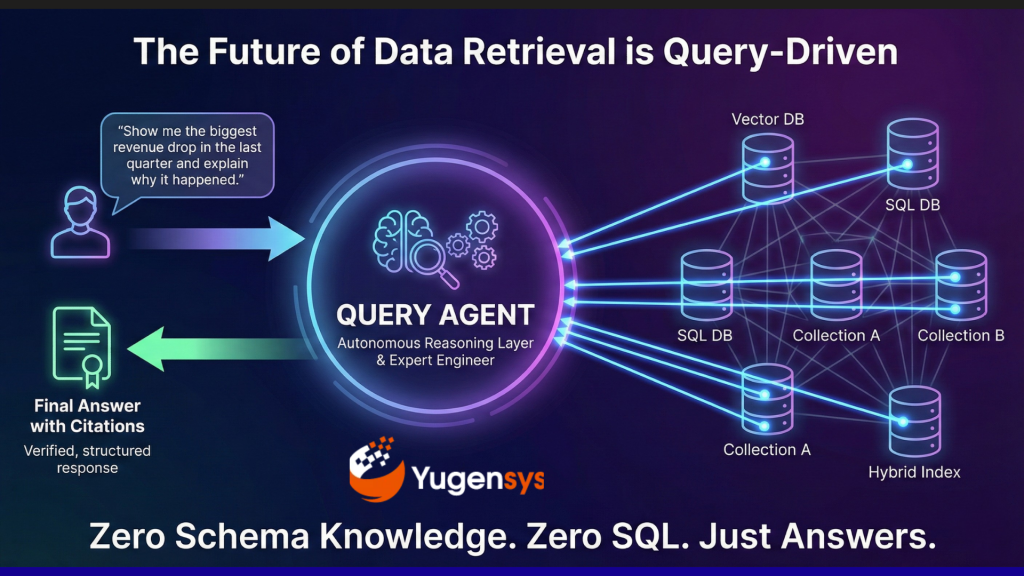
“Show me the biggest revenue drop in the last quarter and explain why it happened.” 

The agent figures out everything else: 
what to search, where to search, how many queries to run, what filters to construct, and how to combine the results. 

The agent becomes the bridge between human natural language and optimized vector/hybrid database retrieval. 

Query Driven Agentic Search Pipeline - How Search Agents Are Replacing Manual Query Writing

The Query-Driven Agentic Search Pipeline

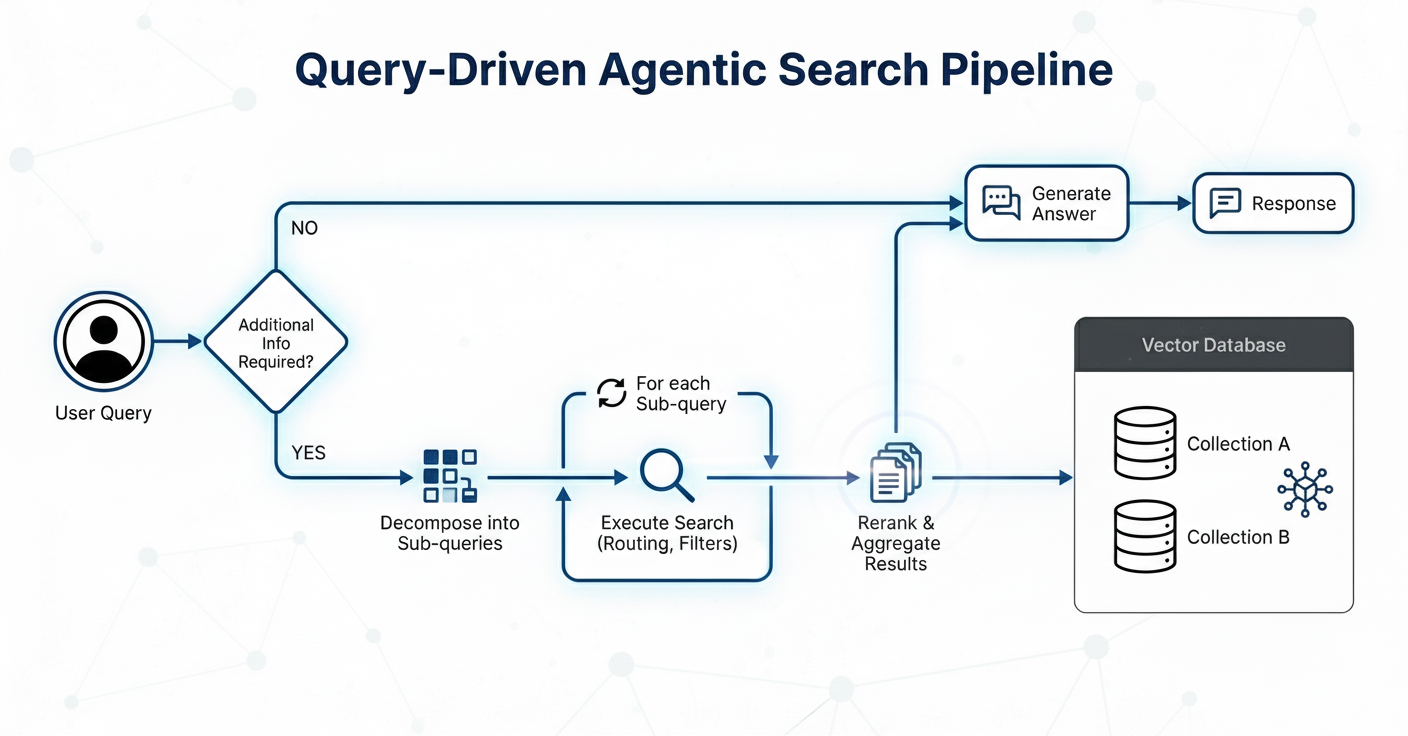
Below is the redesigned architecture diagram showing the complete workflow. 

Let’s walk through each stage in the pipeline.

1. User Query

Everything begins with a natural-language question. 

There’s no need to understand the schema, collection names, or filter syntax. 
The agent receives the question raw—exactly as you ask it. 

Our Services

Book a Meeting with the Experts at Yugensys


2. Determine Whether More Context Is Needed

Before doing any search, the agent evaluates: 

  • Is the question ambiguous? 
  • Is additional context required? 
  • Are there missing parameters the model needs to answer reliably? 

If yes, the agent may reformulate or expand the question internally. 
If no, it proceeds directly. 

This step ensures the system retrieves the right data, not just some data. 

3. Decompose Into Sub-Queries

Complex questions often require multiple independent searches. 

For example: 

“Compare Q3 user churn across Europe vs. US and highlight anomalies.” 

This becomes: 

  • Fetch churn metrics for Europe 
  • Fetch churn metrics for US 
  • Perform anomaly detection 
  • Combine and contrast results 

The agent automatically splits your request into smaller, targeted sub-queries. 

No manual orchestration needed. 

4. Execute Search Across Multiple Collections

The agent now: 

  • selects the right collections (A, B, or more) 
  • performs vector search, keyword search, or hybrid 
  • constructs filters from natural language (e.g., “last quarter” → date range filter) 
  • routes the appropriate sub-query to each source 

It’s doing the work that would normally require multiple schema-aware, filter-precise queries. 

5. Rerank & Aggregate Results

Once raw results come back, the agent: 

  • reranks using semantic relevance 
  • merges results from different collections 
  • deduplicates 
  • applies domain-specific scoring 
  • aggregates metrics if necessary 
  • enforces query intent 

This is where the agent adds real value—it doesn’t just retrieve data; it understands how the results should be combined. 

6. Generate the Final Answer (With Citations)

Finally, the agent turns structured results into a natural-language answer. 

Critically: 
It includes citations pointing back to the original documents or records, giving you transparency and traceability.

7. Response to the User

You receive a complete, well-formed, well-verified answer— 
not a list of raw database hits. 

Why This Pipeline Changes Everything

  1. Zero schema knowledgerequired

You never have to remember field names, relationships, or data types again. 

  1. Zero query writing

No more verbose vector queries, no more manual filtering, no more cross-collection joins. 

  1. Automated multi-step reasoning

The agent decomposes complex questions into dozens of micro-queries you never see. 

  1. Enterprise-grade retrieval quality

With reranking, aggregation, and validation baked in. 

  1. Speed + reliability

The agent executes the entire pipeline in milliseconds—at a quality level far beyond scripted queries. 

Why This Matters for Teams

For analysts, developers, and business users, the Query-Driven Agentic Search Pipeline is a productivity multiplier: 

  • Analysts get clean answers without SQL or schema digging. 
  • Developers offload query building and filtering logic. 
  • Product teams can ship natural-language search features instantly. 
  • Data teams know everyone retrieves data consistently and accurately. 

It’s the closest thing to having a full-time expert database engineer embedded inside your system—one that never forgets schema details, always chooses the best search strategy, and handles all the plumbing automatically. 

The Future Is Query-Driven Search

As databases become more vector-native and agent-augmented, this pipeline becomes the new standard. 

You ask. 
The agent understands. 
The system retrieves, reasons, and answers. 

No query building. No schema digging. No manual routing across collections. 

Just fast, accurate, agentic retrieval built for the modern AI stack. 

Vaishakhi Panchmatia

As the Tech Co-Founder at Yugensys, I’m driven by a deep belief that technology is most powerful when it creates real, measurable impact.
At Yugensys, I lead our efforts in engineering intelligence into every layer of software development — from concept to code, and from data to decision.
With a focus on AI-driven innovation, product engineering, and digital transformation, my work revolves around helping global enterprises and startups accelerate growth through technology that truly performs.
Over the years, I’ve had the privilege of building and scaling teams that don’t just develop products — they craft solutions with purpose, precision, and performance.Our mission is simple yet bold: to turn ideas into intelligent systems that shape the future.
If you’re looking to extend your engineering capabilities or explore how AI and modern software architecture can amplify your business outcomes, let’s connect.At Yugensys, we build technology that doesn’t just adapt to change — it drives it.
Subscrible For Weekly Industry Updates and Yugensys Expert written Blogs


More blogs from Artificial Intelligence

Delve into the transformative world of Artificial Intelligence, where machines are designed to think, learn, and make decisions like humans. This category covers topics ranging from intelligent agents and natural language processing to computer vision and generative AI. Learn about real-world applications, cutting-edge research, and tools driving innovation in industries such as healthcare, finance, and automation.

Expert Written Blogs

Common Words in Client’s testimonial